
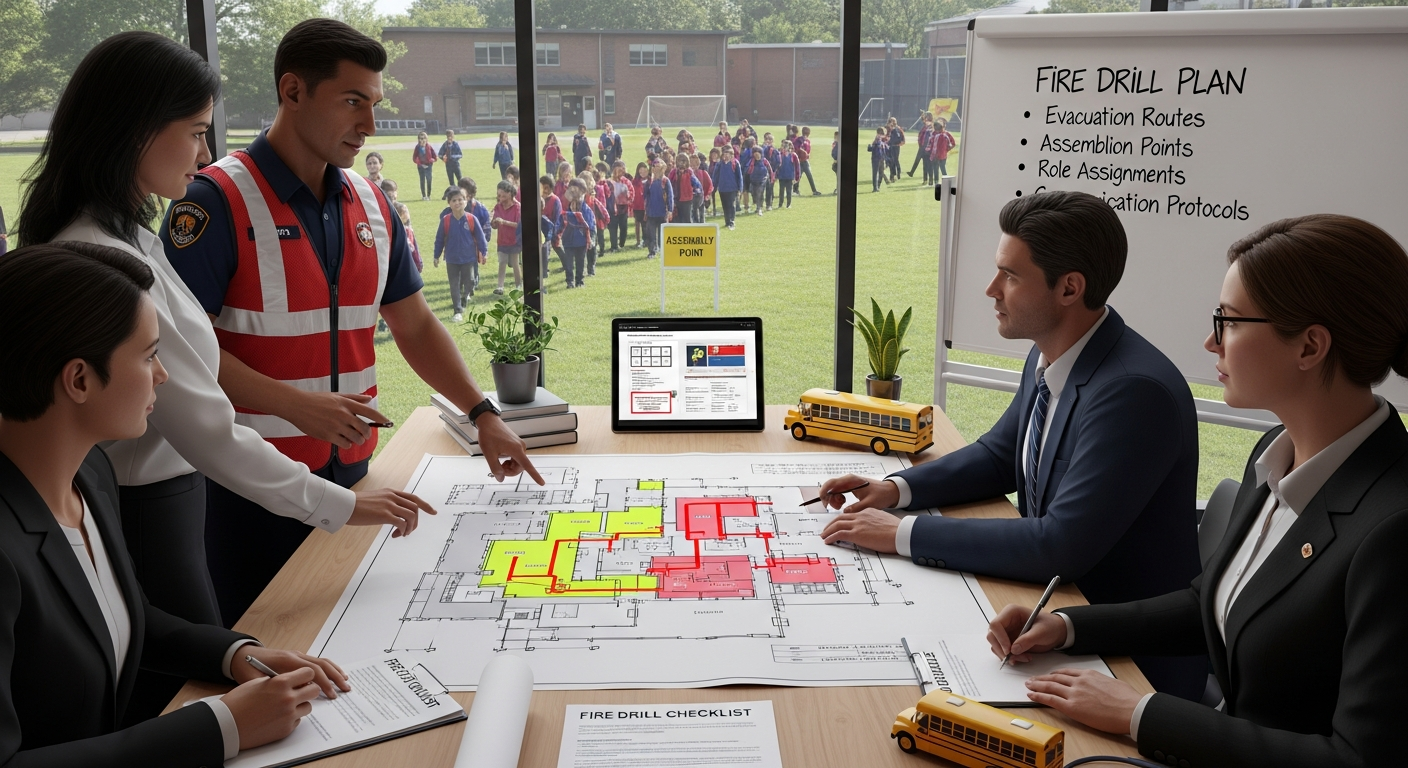
Fire emergencies in schools remain one of the most overlooked risks in many countries, despite hosting the world’s most vulnerable population—children. Learning how to plan fire drills in schools is not just a compliance requirement; it’s a responsibility that shapes the preparedness culture of an entire generation. When planned poorly, drills become a noisy formality. When designed well, they can reduce evacuation time by up to 40 percent, according to several international safety case studies.
The increasing frequency of school infrastructure failures, electrical accidents, and climate-driven fire incidents highlights why administrators cannot rely on outdated safety habits. A modern fire drill plan must blend student psychology, practical fire safety knowledge, structural realities, and repeated simulation to achieve true readiness. This article takes a deep dive into globally proven practices, expert insights, actionable strategies, and real-world examples that schools can adopt immediately.
Why Fire Drill Planning Matters More Than Ever
School buildings often host dense populations; a single block may contain 1,500 students. Fires in such environments escalate fast. Even a small electrical spark can produce thick smoke within minutes, limiting visibility to less than two meters. Research from international fire academies shows that human panic increases evacuation time by nearly 60 percent, especially among young children who have not practiced structured movement.
One safety expert, Dr. Helen Suarez, who has advised schools across Asia and the Middle East, notes, “A fire drill is not just about getting out fast. It is about creating a predictable behavioral response to an unpredictable event.” Her statement reflects the essence of this guide: systematic, repeated preparation saves lives.
Understanding the Core Principles of School Fire Drill Planning
Planning fire drills requires balancing structure, simplicity, and realistic simulation. Schools often make the mistake of assuming students will “figure it out” during an emergency. In reality, structured rehearsals shorten reaction time dramatically.
If a school with 1,000 students manages to reduce hesitation by even five seconds per student, the overall evacuation flow improves significantly. These micro-improvements form the foundation of high-quality planning.
Hesitation Time Calculation Example
- Suppose students take 12 seconds on average to begin moving after the alarm.
- A well-planned drill reduces this to 7 seconds.
- For 1,000 students, this saves 5,000 seconds (≈83 minutes) of collective hesitation time, improving the flow of the entire evacuation chain.
This type of numerical clarity reinforces why structured planning is essential.
Conducting the Initial Fire Safety Assessment
Before a school can plan effective fire drills, administrators must understand their building’s specific risks. A school built in 1998 has different fire load characteristics compared to a modern building designed with steel composites.
A thorough assessment typically covers electrical wiring, stairwell width, fire exit conditions, alarm coverage, fire extinguisher accessibility, and the overall student movement pattern. Schools with multiple floors often face bottlenecks near staircases, while ground-level schools may struggle with perimeter congestion.
Practical Illustration
A mid-size school in Nairobi reported that its average evacuation time was 7 minutes. After assessing that one of the stairways was narrower than recommended, administrators temporarily split student movement across alternative routes. The next drill recorded an evacuation time of 4 minutes and 10 seconds—a dramatic improvement made possible only because the assessment highlighted the bottleneck.
Designing a Practical Fire Drill Blueprint
A fire drill blueprint is the tactical plan that defines who does what, when, and how. It includes teacher duties, student formation, movement patterns, alarm sequences, and safe assembly points.
Fire safety specialists recommend that drills simulate realistic conditions—moderate noise, movement restrictions, or partial visibility—without causing fear or panic. The blueprint must also align with the school’s fire safety policy and local laws.
What an Effective Blueprint Should Include
Even though we avoid bullet points in this article, the blueprint generally includes the alarm initiation procedure, evacuation routes, student grouping, special-needs support, and post-evacuation verification steps. Everything must be documented and communicated clearly to both teachers and students.
Schools that create a blueprint often reduce confusion significantly. One safety officer in Istanbul noted that after implementing a documented plan, teachers began responding within three seconds of the alarm, compared to earlier, inconsistent reaction times.
Integrating the Fire Safety Fundamentals
Fire drills do not work unless students and staff understand basic fire safety principles. A simple classroom demonstration dramatically changes student behavior by showing how smoke rises, how fire spreads horizontally, and how to keep exits unobstructed.
Children tend to imitate patterns they practice. If they regularly see their teachers calmly guiding them toward exits, that learned behavior appears naturally in emergencies. Parents also benefit when schools share fire safety tips, creating a community-wide safety culture.
Expert Insight
Ravi Narang, a fire safety engineer working with South Asian school districts, emphasizes that “education is the backbone of preparedness.” He believes that a school that teaches safety principles reduces panic incidents by almost one-third during drills.
Training Teachers, Staff, and Student Leaders
Teachers are frontline safety responders during school emergencies. A fire drill plan collapses if teachers are unsure of their roles or lack confidence. Schools must invest in repeated training sessions where teachers practice guiding children, controlling speed, and preventing crowd pressure.
Student leaders—often prefects or class captains—can help regulate movement. In one Singaporean school, three trained student leaders per grade reduced line congestion, cutting evacuation time by almost 90 seconds.
A Failure Story as a Lesson
A school in Eastern Europe experienced a chaotic drill when several teachers were absent and no substitutes were assigned evacuation duties. Students became confused, and the intended three-minute drill lasted eight minutes. This failure convinced the school board to assign backup personnel for every section. The next drill ran smoothly at 3 minutes and 40 seconds.
Planning for Students with Disabilities
Inclusive fire drill planning ensures that every child can evacuate safely. Students with mobility, vision, hearing, or cognitive challenges require tailored support.
Some schools assign dedicated “buddy systems” where two trained students accompany a child with special needs. Others invest in evacuation chairs for upper floors, reducing transport time during emergencies.
Practical Calculation Example
If a school has four students with mobility challenges on the second floor and each evacuation chair takes approximately 40 seconds to descend one flight of stairs, the total time becomes 160 seconds. Having two chairs instead of one reduces this to 80 seconds, halving the evacuation time and preventing stairway congestion.
This type of measurable planning prevents life-threatening delays.
Executing the Fire Drill with Realistic Simulation
A common mistake is treating fire drills as a loud, predictable routine. Real emergencies never follow predictable patterns. Therefore, schools should vary drill times, simulate blocked corridors, or run partial-visibility scenarios.
One American middle school intentionally blocked a hallway with cushions representing “debris.” Teachers were forced to redirect students through alternative routes. This incident not only tested their adaptability but also exposed flaws in their initial plan.
Expert Quote
“Predictability kills preparedness,” says veteran fire marshal Daniel Price. “The best drills involve at least one unexpected element that forces participants to think while staying calm.”
Monitoring Performance and Measuring Evacuation Efficiency
Data-driven fire safety planning is the hallmark of modern schools. Tracking start time, movement flow, bottlenecks, and total evacuation duration reveals strengths and weaknesses in the drill.
If a school evacuates in 5 minutes, administrators must analyze whether this time is acceptable for that building layout. International fire safety standards suggest that multi-floor schools should aim for evacuation within 2.5 to 4.5 minutes, depending on density and structural layout.
How to Measure Evacuation Flow
A simple formula:
Evacuation Speed (students per minute) = Total Students ÷ Total Evacuation Time.
A school with 900 students evacuating in 4 minutes has a speed of 225 students per minute. Improving this number requires optimizing stairs, widening hallway movement, or adding alternative exits.
Reviewing the Drill and Implementing Improvements
A fire drill is useful only if followed by a detailed review. Teachers must share observations, students should describe their experience, and supervisors must evaluate video footage if available.
Schools often discover surprising insights during reviews. A school in Brazil found that students tended to stop near the building entrance because they had no clear visual markers guiding them to the assembly point. Adding bright signage improved discipline and reduced clustering.
Reviews should not feel punitive. Instead, they must focus on constructive improvement, especially for younger children who respond better to reassurance than criticism.
Communicating Results with Parents and the Community
Transparent communication builds trust. Parents deserve to know that the school has a reliable safety system and a proven evacuation plan. Sharing drill results, improvements, and safety initiatives builds confidence and encourages families to practice fire safety at home.
Some schools publish quarterly safety newsletters summarizing drill performance, safety workshops, and expert feedback. This connects school-based safety culture with community behavior, improving overall resilience.
Strengthening Long-Term Fire Safety Culture
Planning fire drills is not a one-time activity. Schools must embed a long-term fire safety culture that includes training programs, teacher certifications, annual equipment testing, and student awareness activities.
Culture develops through repetition. After four or five properly conducted drills, students begin responding effortlessly, much like athletes who train repeatedly to build muscle memory. Such readiness becomes crucial during real emergencies when instinct replaces conscious decision-making.
Conclusion: Building Safer Schools Through Smarter Fire Drill Planning
Learning how to plan fire drills in schools is a powerful investment in student safety and public trust. Every drill strengthens instinct, reduces panic, and enhances the fire safety readiness of the entire school community. When paired with strong planning, teacher training, and inclusive practices, fire drills become more than compliance—they become a life-saving habit.
The world continues to witness fire-related school tragedies, many of which could have been avoided with better planning and rehearsed evacuation systems. This article provides a globally relevant, practical framework aligned with modern fire safety standards. Schools that start implementing these recommendations today will build safer environments tomorrow.
Effective fire safety begins with a single drill, repeated, refined, and reinforced until it becomes second nature for every child and adult in the building.
References (Credible Sources)
- National Fire Protection Association (NFPA) provides guidelines for fire drills.
- International Fire Safety Journal—School Evacuation Studies
- United Nations Office for Disaster Risk Reduction—School Safety Framework